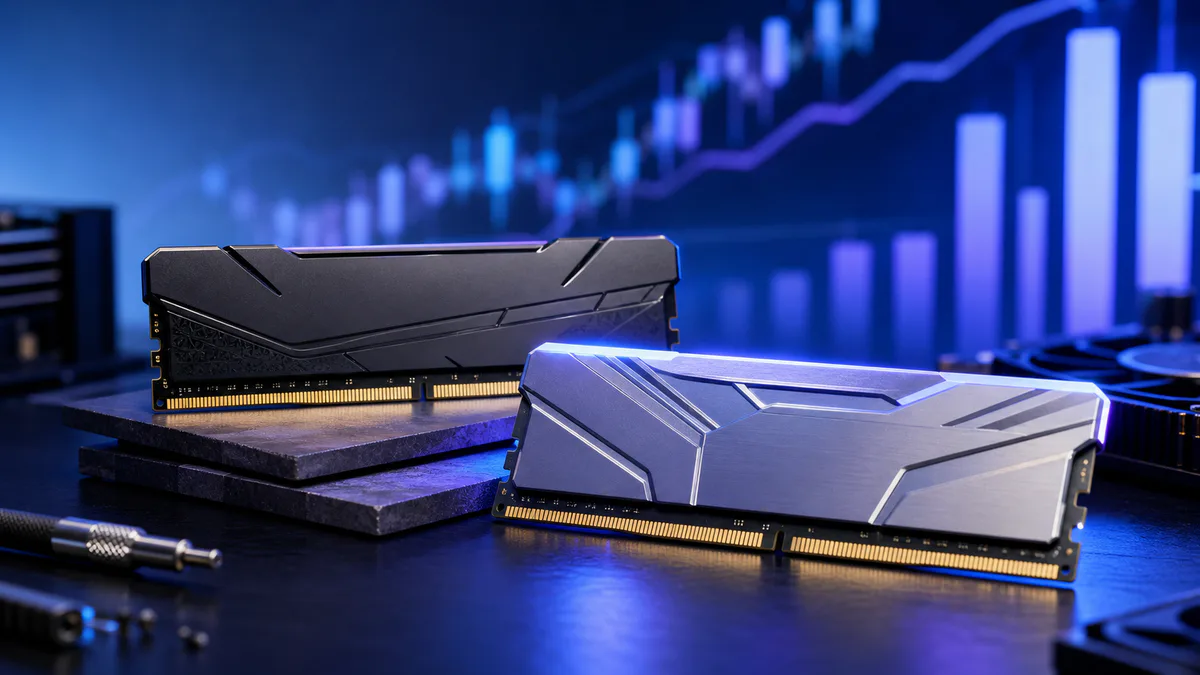


Two memory-market signals landed this week, and they point in opposite directions. Tom's Hardware reports that a Lenovo executive, speaking at ISC 2026, described the current "RAMageddon" as the new normal, saying the memory market "will never be like it was last year." In the same window, Tom's Hardware also flagged a DDR5 kit hitting a record-low price. For anyone deciding whether to buy RAM now or wait, that contrast matters more than either headline alone.
What the cheap kit actually is
The deal is a PNY Performance 32GB DDR5-5600 kit (2x16GB), which Tom's Hardware reports became the cheapest 2x16GB option after a $70 discount. The appeal is the price, not the specification. The coverage cited the low cost rather than timings or design as the reason to consider it.
That distinction matters. A record-low price on a modest kit is not the same as a record-low price on fast, tightly timed memory. If your build is bandwidth-sensitive — high-refresh gaming, some creative workloads — DDR5-5600 is a baseline, not a performance bargain. For a general-purpose desktop, 32GB at this speed covers most users, and the discount makes it a sensible buy on merit.
Why prices are rising elsewhere
The wider market is why the "new normal" framing carries weight. The Register describes RAM as "suddenly valuable," tying the point to a Portuguese bank's storage situation. The broad read is that memory and storage demand is tightening supply, and that vendors expect elevated pricing to persist rather than snap back.
Be precise about what is claimed. Lenovo's comment is a vendor forecast, not a guarantee, and companies that sell hardware have reasons to set expectations for higher prices. The signal is real, but "will never be like it was last year" is a directional warning, not a fixed price floor.
Buy now or wait
The decision comes down to whether you need the RAM soon and whether the kit in front of you is priced well today.
- Building or upgrading now: a genuinely discounted kit at the capacity and speed you need is worth taking. The market signals suggest waiting is more likely to cost you than save you.
- Speculating: buying RAM you do not yet need, on the theory it will appreciate, is a gamble. Memory depreciates over a normal product cycle. Stockpiling on a price rumour is not an upgrade.
- A discount on the wrong kit: a cheap 5600 kit is not a reason to compromise on capacity or compatibility. Match the memory to your platform and workload, then judge the price.
For shoppers unsure about speed, capacity and dual-channel basics, our RAM buying guide and the glossary cover the terms that matter before you commit.
Laptop buyers: the calculus is different
If you are shopping for a laptop rather than parts, memory pricing is largely baked into the sticker and harder to act on. The relevant question is whether a machine holds up over time. Tom's Guide spent two weeks with the MSI Prestige 16 AI+ and rated its OLED refresh strong but concluded the laptop misses a few marks — the kind of detail a spec sheet will not surface. Wired's current roundup of Prime Day laptop deals spans MacBooks to gaming laptops, a reasonable starting point if price is the constraint. Our laptop comparisons are the place to weigh specific models.
Further out, Engadget reports, citing Mark Gurman, that Apple's rumoured touchscreen MacBook is expected to launch with M5 Pro and M5 Max chips rather than waiting for an M7 generation. That is a reason for some buyers to hold, but it remains a report about an unannounced product.
The bottom line
The memory market is tightening, and at least one vendor expects it to stay that way. That makes a well-priced kit you actually need a reasonable buy today. It does not make memory worth hoarding. Buy for the build in front of you, judge the kit on capacity, speed and price rather than the discount headline, and ignore forecasts you cannot act on. More on the wider market sits in our computing coverage.