

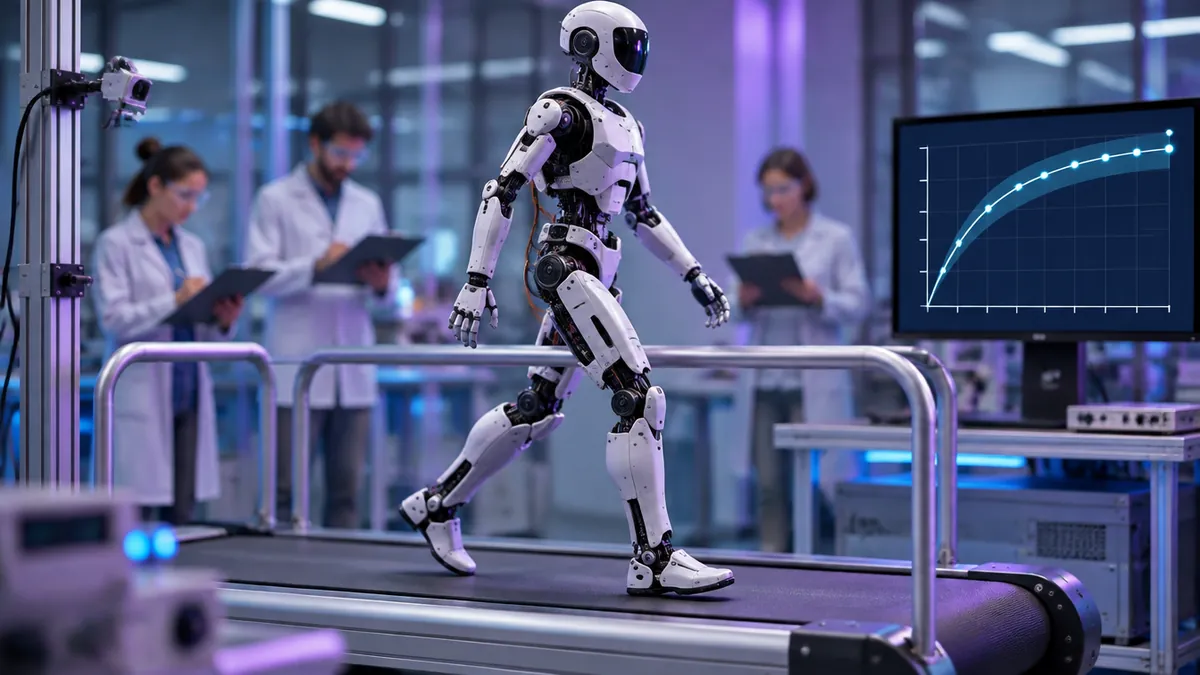
Three stories from one week share a theme: humanoid robots are starting to meet real conditions instead of staged demos, and the results are mixed. A Shanghai convenience store ran six humanoid robots through a 24-hour shift. South Korea opened a government-backed facility built to teach robots real-world tasks. Agility Robotics became a public company, and its stock barely moved on day one. None of this is a breakthrough. It is a reality check, and it is the kind of data buyers should be watching.
The Shanghai trial: two of six did not pass
According to Interesting Engineering, six humanoid robots worked a full 24-hour shift in a Shanghai convenience store, greeting customers throughout. Two of the six failed their assessment. The report does not specify which models or what the assessment measured, but the result stands on its own.
That matters because two failures from a six-robot fleet is not a rounding error, especially in a task this low-stakes: greeting customers involves no object handling, no navigation around moving shoppers, no cash or inventory responsibility. If robots stumble here, buyers should assume the gap between a conference-stage demo and a working shift is wider than vendors tend to advertise. Anyone comparing options should weigh this against spec sheets rather than promotional video: the humanoid spec sheet is a better starting point than a highlight reel.
Agility Robotics goes public, quietly
Agility Robotics' Nasdaq debut was the other headline event of the week, and it was deliberately unremarkable. The Robot Report said the stock closed its first day of trading just 2% above its opening price, at $11.49. No surge, no crash. For a sector accustomed to hype, a flat debut is itself information: public markets appear to be pricing humanoid robotics as an industrial bet with real execution risk, not a speculative moonshot.
South Korea bets on training data, not showmanship
The third data point is structural rather than theatrical. Interesting Engineering reports that South Korea's government has launched what it describes as the first facility of its kind: a humanoid robot data factory built specifically to teach robots real-world tasks. That is itself an admission that the current bottleneck in humanoid robotics is not hardware: it is training data for messy, unscripted environments. A government funding a dedicated factory for this, rather than leaving it to individual labs, suggests the industry expects the sim-to-real gap to take sustained, organized effort to close.
Everyone else is chasing the same gap
That gap runs through the rest of this week's news too. TechCrunch Robotics reports that Physicl raised $10 million to build a pipeline aimed at closing the sim-to-real gap, making simulated training realistic enough that skills learned there transfer reliably to physical robots. Separately, Serve Robotics is launching a new business line, Physical AI Services, offering customers its connectivity and data tools, a sign that infrastructure and data are where near-term value is shifting, not hardware alone.
Boston Dynamics' approach points the same direction from the hardware side. The Robot Report notes the company spent two and a half years developing Stretch Gen 2 specifically to deliver more reliable, consistent performance, not new capabilities. That is a long cycle for an incremental reliability gain, and it underscores how hard consistency is to engineer once a robot leaves a controlled demo.
Not every account this week was downbeat. MIT Technology Review published a first-person account of a humanoid robot cleaning an apartment, and the writer described it as feeling like a taste of the future. The capability is real and improving. The Shanghai numbers are a reminder that real and improving is not the same as reliable at scale, yet.
What this means for buyers
None of this week's news is a verdict against humanoid robotics. It is a shift in what counts as evidence. A demo video shows what a robot can do once, under ideal conditions. A 24-hour retail shift shows what a fleet does across the conditions a real deployment produces, including the ones some units fail in. Anyone scoping a pilot should ask vendors for shift-level reliability data, not just capability claims, and weigh pricing and deployment questions accordingly: the price tracker and the best humanoid robots rankings are built around that distinction. The hype cycle and the reliability data are running in the same week now, side by side. That is the more useful story.
Sources: Interesting Engineering, The Robot Report, TechCrunch Robotics
Written with the help of AI tools, from published sources, under our editorial rules. Illustration generated with AI. No commission on purchases. Learn more