
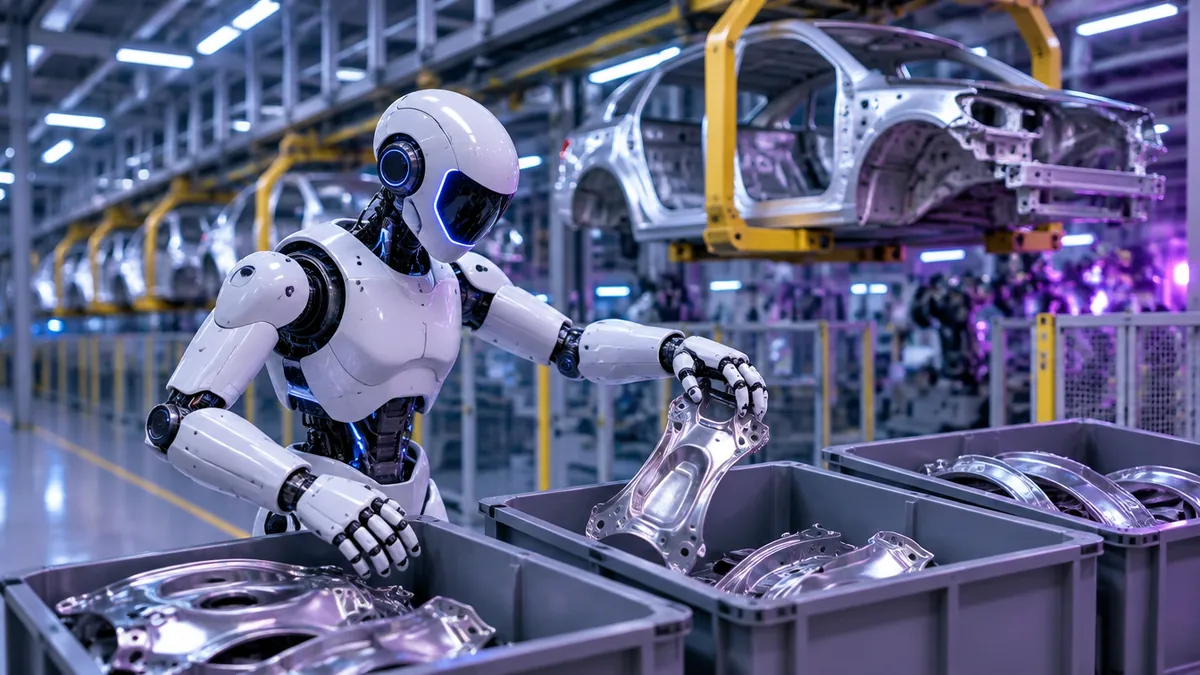
Anyone budgeting for a humanoid robot this year should read one line from the new AI100 report closely: embodied AI remains a grand challenge for artificial intelligence research. That is the report's own framing, not a footnote caveat. The autonomy pitched in humanoid robot demos, the ability to perceive, reason and act reliably in unstructured physical space, is exactly what the report flags as unresolved.
What the AI100 report actually says
According to Robohub, the AI100 report's 2026 edition, the third in the series, lists embodied AI among AI research's grand challenges. A grand challenge is a problem the field has not cracked, not a feature with a known fix timeline. For buyers, that distinction resets expectations: the "brain" behind a walking, grasping, task-completing robot is still being built in labs, not shipped as a finished component.
That matters for anyone comparing specs on our humanoid robot comparison or checking prices on the price tracker. A vendor's autonomy claim is a marketing position until it is demonstrated outside a controlled demo. The report gives buyers a research-community benchmark to measure those claims against.
General AI is moving fast, robots are not
The contrast is sharp because other parts of AI are showing rapid, measurable progress this same stretch. Google DeepMind's AlphaProof Code used Gemini Carbon-powered AI agents to write more than six million lines of proof code, verifying Signal's cryptographic core in four weeks instead of the years such verification typically takes, The Decoder reported. That is a concrete result in a narrow domain: code correctness, not open-world physical manipulation.
Anthropic reports a related infrastructure claim: its in-house Mythos model ported Claude to AMD GPUs in three days with almost no human intervention, work it describes as eroding Nvidia's CUDA lead, per The Decoder. That is a software-and-chip portability result, a different problem than getting a robot arm to reliably pick up an unfamiliar object in a cluttered room.
Google also launched the Gemini Decisions API, powered by Gemini Decision 1, according to MarkTechPost, priced at $0.10 per 1 million tokens for calibrated yes/no, choice and rubric questions across text, images, audio, video and PDFs. The Decoder reports it can score up to 1,000 closed-ended questions in a single pass and return results in 150 to 250 milliseconds. That is a fast, cheap, well-bounded classification task, not a proxy for the continuous, error-tolerant decision-making a robot needs to navigate a home or warehouse floor.
The pattern: genuine, verifiable progress where the problem is digital, boundable and checkable. Embodied AI is none of those things by default, which is why the AI100 report singles it out.
The market is getting more cautious too
There is a financial signal pointing the same direction. US corporate AI spending growth slowed to 1.65 percent in October 2026, according to the Ramp AI Index cited by The Decoder, with just one percent of companies still driving 80 percent of OpenAI and Anthropic revenue. That is not a humanoid-specific figure, but it shows buyers broadly are moderating how fast they commit budget to AI claims generally. The same discipline should apply to humanoid robot purchases: enthusiasm for a capability demo is not evidence the capability is reliable, repeatable and supported at scale.
On the funding side, IEEE Spectrum reports that the NSF's X-Labs program, which funds higher-risk, higher-funded research partnerships, is drawing new support from charities and investors. That shows serious money still sees embodied AI and related hard problems as worth funding at the frontier, consistent with the AI100 report's grand-challenge label rather than contradicting it. Research-stage investment and a shipped, reliable product are two different things.
What this means for a buying decision
None of this means humanoid robots are not useful today. It means the gap between a slick autonomy demo and a robot that reliably completes tasks unsupervised is, per this report, an open research question industry-wide, not a solved detail specific to one vendor. When comparing options on our best humanoid robots list treat any claim about independent decision-making, novel-task generalization or unsupervised operation as a claim to verify, not a given.
Before committing budget, ask:
- What tasks has the robot performed outside a demo environment?
- Is the autonomy claim backed by deployed, repeated use, or a single filmed run?
- Does the vendor disclose failure rates or supervision requirements?
Those questions apply the same scrutiny the AI100 report's authors apply at the research level. The fast-moving results from Google DeepMind, Anthropic and Google's Decisions API are real and worth tracking (see our AI news coverage for updates), but they live in domains with clear success criteria. Embodied AI does not have that clarity yet. Until it does, treat a humanoid robot's autonomy marketing as a claim in progress, not a finished product spec.
Sources: Robohub, The Decoder, MarkTechPost
Written with the help of AI tools, from published sources, under our editorial rules. Illustration generated with AI. No commission on purchases. Learn more