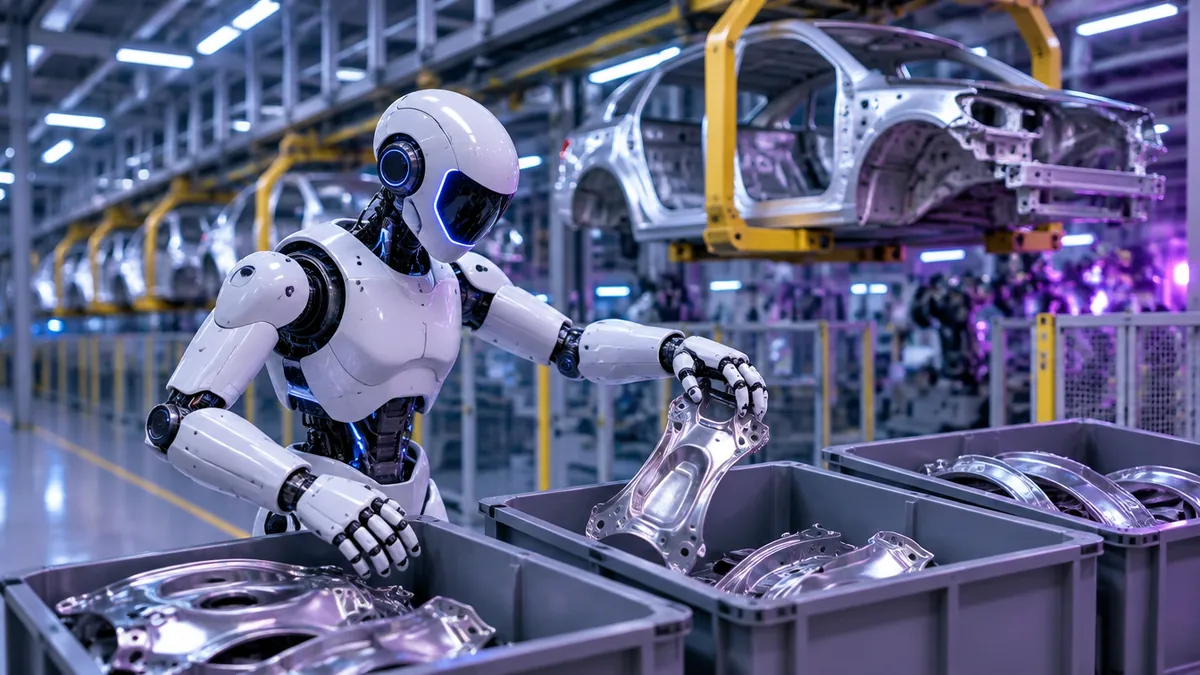

Google DeepMind has tested its new Gemini Robotics 2.5 control model with Apptronik's Apollo 2 on active Mercedes-Benz production lines in Hungary and Germany, according to The Decoder. The humanoid sorted metal parts as part of the pilot, on a line that was already building vehicles, not in a lab or a staged demo.
That distinction matters for anyone evaluating humanoid platforms for industrial use. A capability shown at a keynote is not the same as one holding up on a line that cannot stop for a robot's mistake. Interesting Engineering reported that Gemini Robotics 2.5 scored 96 percent across 200 tasks in the factory trial. That is a single vendor-reported trial result, not an independent industry benchmark, and it should be read that way.
Why a production pilot is a different signal
Most humanoid news still arrives as a demo: a robot folding laundry, pouring a drink, walking across a stage. Those clips show a capability exists under chosen conditions. They say little about reliability, cycle time, or what happens when a part is slightly out of position. A pilot on a Mercedes-Benz line, even a limited one, means the robot and its control software held up long enough, and consistently enough, for an automaker to let it near real output.
For procurement teams, that is the harder test. This pilot is the first evidence tying Apollo 2 to an actual automotive customer on a live line. It does not confirm the platform is ready for broad deployment. It confirms Apptronik and Google DeepMind got further than a stage demo, which is a meaningfully different claim.
A framework for measuring real output
The timing matters because of a second development. AGIBOT is proposing a new way to measure the useful work humanoid robots actually complete after deployment, rather than relying on capability demos alone, according to Robotics & Automation News. Current comparison tools lean heavily on task lists and spec sheets: degrees of freedom, payload, battery life, which tasks a robot has been shown doing at least once.
A deployment-output framework, if other vendors adopt it, would let buyers compare platforms on completed work rather than demonstrated potential. That depends on vendors reporting consistently and on independent verification, not companies grading their own pilots. Until a standard exists, buyers should ask vendors directly for deployment data rather than infer it from a demo reel.
Competitors are chasing the same credibility
Apptronik is not alone in trying to move from demo to deployment. Oversonic Robotics, the Italian maker of cognitive and collaborative humanoid robots, is taking its RoBee R20 to Munich and Lisbon as part of an international expansion, per Robotics & Automation News. Moving into Germany, an established industrial and automotive market, is a different test than a trade show floor.
The software layer is moving too. Nvidia's GR00T 2 model is built to teach robots new tasks by transferring human hand movements from video, trained on roughly 400,000 hours of footage, without requiring teleoperation, The Decoder reported. That is a different approach from Gemini Robotics 2.5's line-tested control, but it points the same direction: the competition is increasingly about whose software generalizes to new tasks fastest, not just whose hardware looks most capable on screen.
Capital is following the same shift. Path Robotics, a developer of physical AI for manufacturing, raised $300 million in Series E financing at a $2.45 billion valuation, Robotics & Automation News reported. The round is not for a humanoid platform, but it confirms investor appetite for physical AI aimed specifically at manufacturing.
What this means for buyers
None of this amounts to a finished product. The Mercedes-Benz work is a pilot, and a 96 percent score on 200 tasks in one trial is not a validated production rate across shifts, parts variety and months of wear. Oversonic's Munich and Lisbon push is an expansion plan, not a completed one.
What it does confirm is a shift in what counts as evidence. Buyers comparing platforms should weigh documented production pilots, and deployment-output figures as that framework matures, more heavily than capability demos. The price tracker and best humanoid robot rankings are useful starting points, but a line actually running at Mercedes-Benz, or an independently verified deployment-output figure, will tell a procurement team more than another viral clip.
Sources: The Decoder, Interesting Engineering, Robotics & Automation News
Written with the help of AI tools, from published sources, under our editorial rules. Illustration generated with AI. No commission on purchases. Learn more