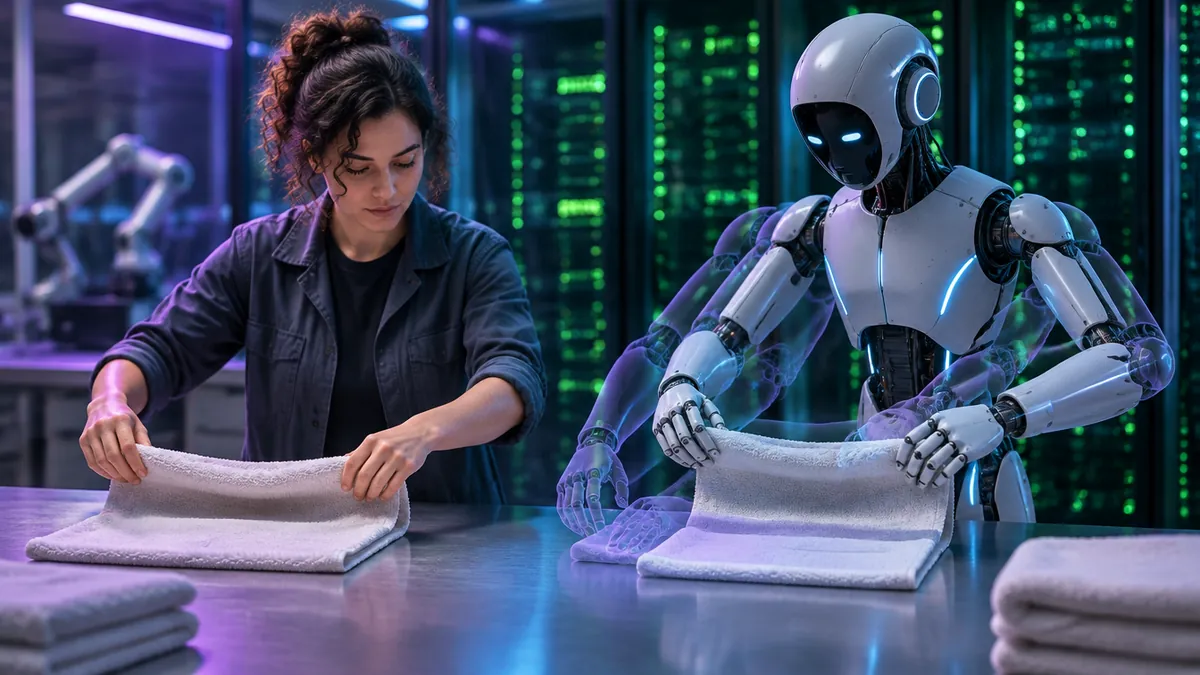
NVIDIA has introduced GR00T 2, a new generation of robot foundation models that, according to Interesting Engineering, can transfer a human skill to a robot from just five task demonstrations. If that number holds up outside NVIDIA's own demos, it reframes what matters when shopping for a humanoid robot: not just what the hardware can do on day one, but whether the software running it can learn new tasks after the robot is already on the floor.
For buyers comparing humanoid robots that is a real shift. Joints, payload and battery life used to be the whole comparison. Increasingly, the more useful question is which foundation model a given robot runs, and whether its maker actually ships updates to it.
Why the demonstration count matters
A robot programmed at the factory does exactly what it was built to do until an engineer rewrites its control software. A robot running a foundation model like GR00T 2 is designed to generalize: show it a handful of examples of a new task, and it adapts. Interesting Engineering reports GR00T 2 needs as few as five demonstrations to transfer a skill. If that holds in commercial deployments, not just NVIDIA's demos, a unit bought today could do more a year from now without a hardware swap.
That distinction is worth pressing a vendor on directly: ask whether the robot runs an updatable foundation model or fixed programming. The answer determines whether a purchase is a snapshot of current capability or a platform that can grow. Five-shot skill transfer is a model-level claim, not proof that any specific commercial robot ships it today, so verify what a product actually does now against what its underlying model is claimed to be capable of.
Cheaper compute changes the economics
GR00T 2 arrived alongside a cluster of announcements about cheaper, faster AI compute, and that context matters for anyone weighing whether to buy now or wait. Google added two specialized systems to its eighth-generation TPU lineup, targeting up to 80% better inference price performance, per Interesting Engineering. MarkTechPost detailed the two chips: TPU 8i Max, which packs two TPU 8i chips per package for long-context agent workloads, and TPU 8tx, which adds hardware confidential inference. The Decoder reports Google is now shipping four TPU variants within a single year as it ramps up competition with NVIDIA.
Separately, Meta launched Muse Ember, which The Decoder describes as its smallest and most efficient AI model, built for the repetitive tool-call, routing and data-extraction work that AI agents handle. The Next Web reports Meta says it matches Claude Haiku's performance at a third of the cost per task.
None of these are robotics products. But a humanoid robot's decision-making runs on exactly this kind of infrastructure: inference chips and smaller models handling the tool-calling that lets a robot interpret a scene and choose an action. Cheaper inference will not make GR00T 2 smarter on its own, but it lowers the cost of running and updating the agentic stack robots depend on, one more factor in a buy-now-or-wait decision alongside price, support and whether the task you need is covered today. The compute race behind it continues, as tracked in our AI news coverage.
The complexity that comes with it
The more capable these systems get, the more moving parts they involve. IEEE Spectrum AI reports that teams are now building task forces of AI agents managed by an orchestrator: a setup the publication says is testing the limits of zero-trust security for autonomous agent systems. That is a statement about where the underlying agent stack is headed, not about any specific robot's security. But it is a reminder that "the robot learns on its own" describes a multi-agent software system, and buyers should ask how it is secured and governed, not just how capable the demo looks.
What this means for a purchase
- Ask about the model, not just the machine. A robot locked to its original programming is a different product than one on an updatable model, even if the spec sheets look identical.
- Treat demo claims skeptically. A capability shown in a lab demo is not a guarantee of what ships in a commercial unit today.
- Factor compute costs into timing. Cheaper inference hardware and smaller models suggest capability may keep improving without a new hardware purchase, worth weighing against current listings on our price tracker.
Degrees of freedom, payload and battery life still matter, and they remain the fastest way to rule models in or out on our best humanoid robots list. But set against a week of cheaper-inference announcements, GR00T 2's five-shot learning claim points to where near-term capability gains are likely to show up: the software layer, not the next hardware revision. Buy for what a robot can demonstrably do today, and treat any claim about what it will learn tomorrow as a maybe, not a spec.
Sources: Interesting Engineering, MarkTechPost, The Decoder, The Next Web, IEEE Spectrum AI
Written with the help of AI tools, from published sources, under our editorial rules. Illustration generated with AI. No commission on purchases. Learn more