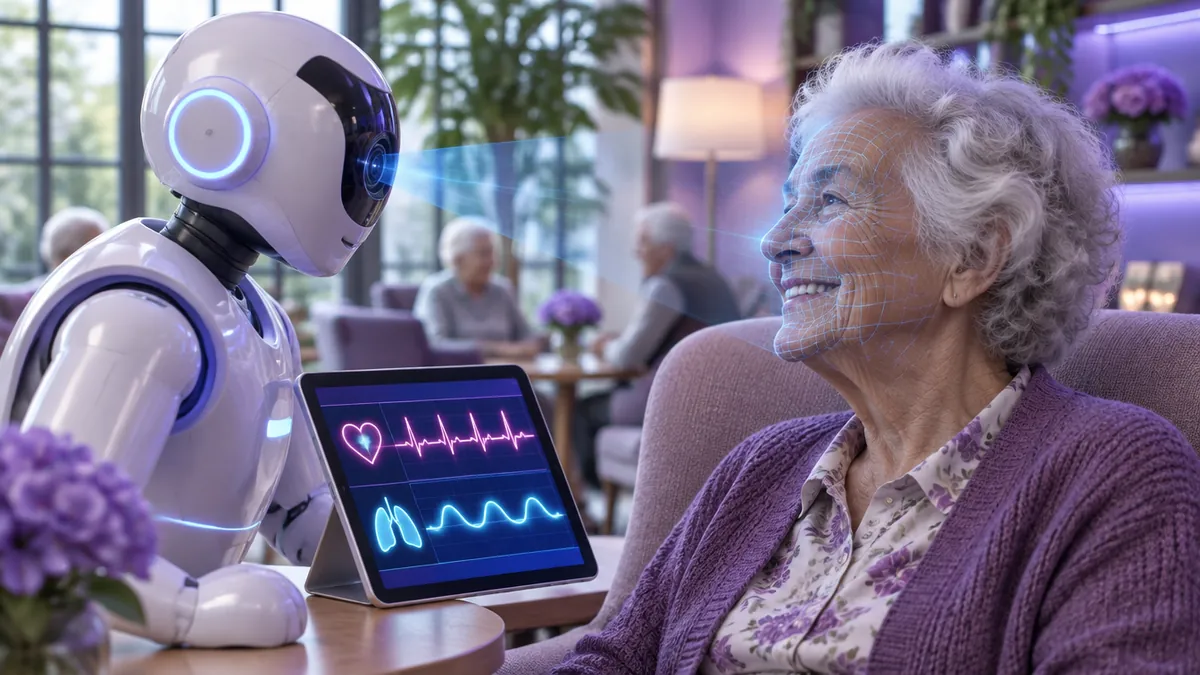

IntelliProve has raised €2.7 million in seed funding to extend its camera-based health-scan tool from virtual care apps onto humanoid robots, according to The Next Web. The round was led by Miles Ahead. Home nursing organisation Wit-Gel is named alongside the announcement, pointing to care-sector interest in the feature.
The technology itself is not new. IntelliProve's scan was built for virtual care apps, where a camera reads vital signs from a person's face. What's new is the destination: that same scan is being adapted to run on humanoid hardware. For buyers evaluating a humanoid robot for a home or care setting rather than a warehouse floor, that is the detail worth tracking, not the funding number itself.
Why this matters for buyers, not just investors
Most humanoid robot comparisons to date have centered on mobility, manipulation and payload: specs that matter for logistics and manufacturing. A care-oriented robot answers to a different checklist, and passive, camera-based monitoring (no wearable, no physical contact) sits squarely on it.
A health check running on the robot itself, rather than in a separate app, addresses that gap directly. It also raises questions worth asking before treating it as a given: how the scan performs on an actual humanoid platform versus a phone or laptop camera, what accuracy and latency look like outside the pitch deck, and whether the feature will ship on an actual robot or stay a pilot limited to a single nursing partner. This is an extension of an existing app, not a robot-first product: that reads as a research preview, not a shipped feature. Nothing in the available reporting indicates these health-scan robots are shipping to consumers yet.
Part of a broader shift toward higher-value capabilities
IntelliProve's move lands alongside other robotics-investment signals pointing the same direction. The Robot Report reports that Humyn Labs raised $47 million to collect real-world data for frontier AI labs, robotics companies and world-model developers. Separately, TechCrunch Robotics reports that Toyota's venture arm, Woven Capital, is increasing its investment in robotics and physical AI beyond the automaker's core car business.
Taken together, these moves echo what The Robot Report has described as the field's next challenge: turning better perception into capable real-world action, often called embodied intelligence, as both AI models and hardware mature. A robot that can read a person's vitals from its own camera is one concrete instance of that shift: perception doing something a buyer can actually evaluate.
What to ask vendors now
No humanoid platform has been named as a carrier for IntelliProve's tool yet. That itself is useful: this is an early-stage capability, not a feature differentiating specific models on the market today. For institutions and households evaluating humanoid robots for care roles, the practical move is to start treating health-sensing as a question to ask directly, the same way you'd ask about battery life, uptime or total cost of ownership:
- Is passive health monitoring on the roadmap, or only available through a separate app or wearable?
- What vitals are measured, and what is the claimed accuracy versus a clinical device?
- Is this a shipped feature or a pilot limited to specific care partners?
- Who owns the health data the robot collects, and how is it stored?
Until vendors answer those questions concretely, health-sensing belongs in the "watch" column, not the "buy" column, of any humanoid comparison. Track ongoing coverage on our robotics news and compare current hardware on the price tracker and our best humanoid robots picks: none yet lists a shipping face-scan health feature.
Sources: The Next Web, The Robot Report, TechCrunch Robotics
Written with the help of AI tools, from published sources, under our editorial rules. Illustration generated with AI. No commission on purchases. Learn more