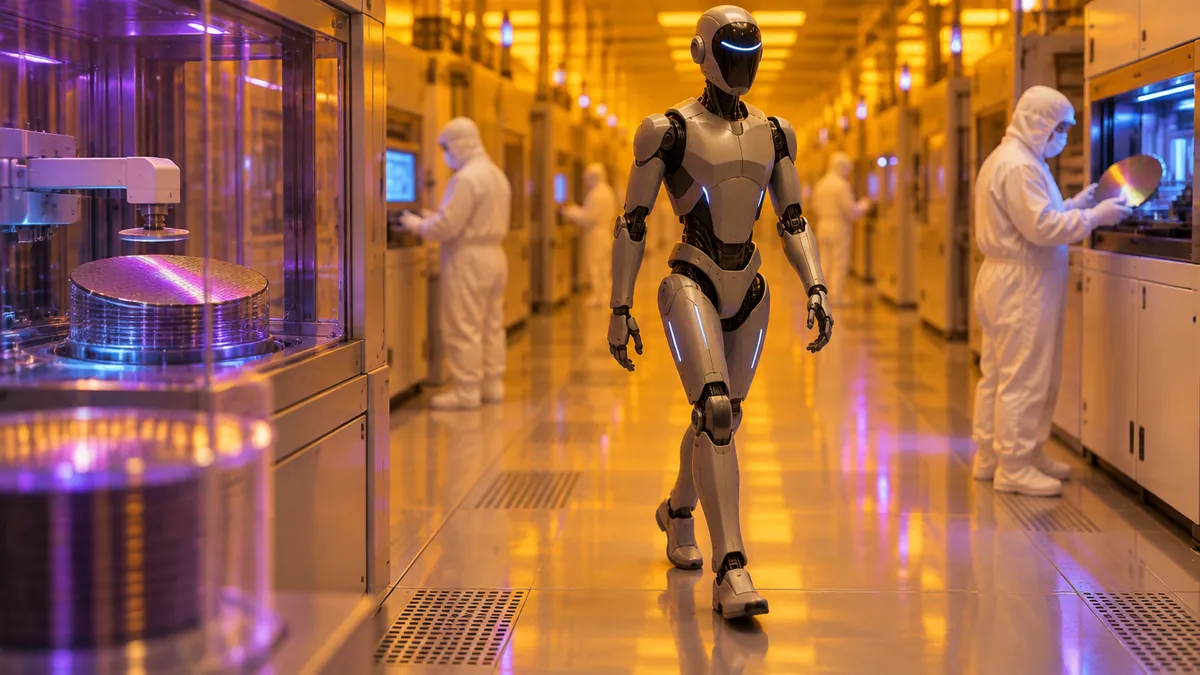
Boston Dynamics will test Atlas outside the automotive industry for the first time, at a major semiconductor manufacturer, with trials planned for early 2027. The Robot Report and Interesting Engineering both report the same timeline. For anyone tracking the humanoid robot market that fact is worth more than most keynote demos: it says something concrete about where this hardware is actually headed, not where it was shown off.
Atlas has so far lived inside car plants. Semiconductor fabrication is a different environment: tighter cleanliness requirements, different part sizes and tolerances, and workflows that were not built around a bipedal robot. Whether Atlas can do useful work there, not just walk through it, is the real test, and neither source has published task-level results yet.
Why the venue matters more than the demo
A spec sheet lists degrees of freedom, payload and battery life. It does not say whether a platform can be redeployed to a new industry without a multi-year integration project. A trial outside automotive tests exactly that: whether hardware and software that worked on a car line can be retargeted to new tasks in a new facility on a short timeline. If Atlas performs well in semiconductor manufacturing, that is a real signal about generalization. If it struggles, that is informative too. Either way, where a robot is actually running beats a staged lift-and-carry clip. Current specs and prices are tracked on our price tracker.
Manipulation, not mobility, is the bottleneck now
Separately, TechCrunch Robotics reports that Genesis AI raised $500 million in Series A funding to deploy glove-wearing robots, built on what the company describes as a novel approach to training robot dexterity. Gloves suggest a design choice toward closer-to-human grip and tactile handling, rather than simpler grippers. Picking up irregular objects and handling delicate parts remains the harder, less photogenic problem for humanoid platforms generally. Buyers evaluating a platform for anything beyond transport or inspection should weigh manipulation capability as heavily as mobility specs. Our best humanoid robots guide and the Atlas spec page are a good starting point for that comparison.
The programming problem behind robot failures
The Robot Report's industry analysis argues that a hidden reason most robots fail on the factory floor is not hardware: it is programming complexity. The case for AI-native robotics, where behaviors are learned rather than hand-coded for every task variation, is that it could make automation meaningfully easier to deploy and reprogram when conditions change. That lines up with a separate observation from Robohub: behaviors robots learn through trial and error in simulation are increasingly transferring to work on real, physical robots. Moving a robot into a new industry, as Boston Dynamics is doing with Atlas, is exactly the reprogramming challenge that AI-native, simulation-trained behaviors are supposed to shorten.
What buyers should actually track
None of this is a product announcement. The semiconductor trial is a research preview, not a commercial rollout, and early 2027 is a test date, not a ship date. Elsewhere in autonomy, Wired reports that Tesla has invited some buyers to reserve a personal robotaxi, the Cybercab, raising questions about the future of car ownership. It is a different machine and a different category, but the same caution applies: an invitation to reserve is not a deployment.
For procurement teams actually evaluating humanoid platforms, three things are worth tracking as this unfolds:
- Whether Boston Dynamics reports concrete task outcomes from the semiconductor trial, not just footage of Atlas on the fab floor.
- Whether moving Atlas from automotive to semiconductor required hardware changes, or was mostly a software and task-training exercise.
- Whether manipulation-focused entrants like Genesis AI's gloved robots start appearing in sectors where dexterity, not mobility, is the bottleneck.
Wait for task-level outcomes from the trial, not the announcement date, before treating Atlas as fab-ready.
Sources: Interesting Engineering, The Robot Report, Wired, TechCrunch Robotics, Robohub
Written with the help of AI tools, from published sources, under our editorial rules. Illustration generated with AI. No commission on purchases. Learn more