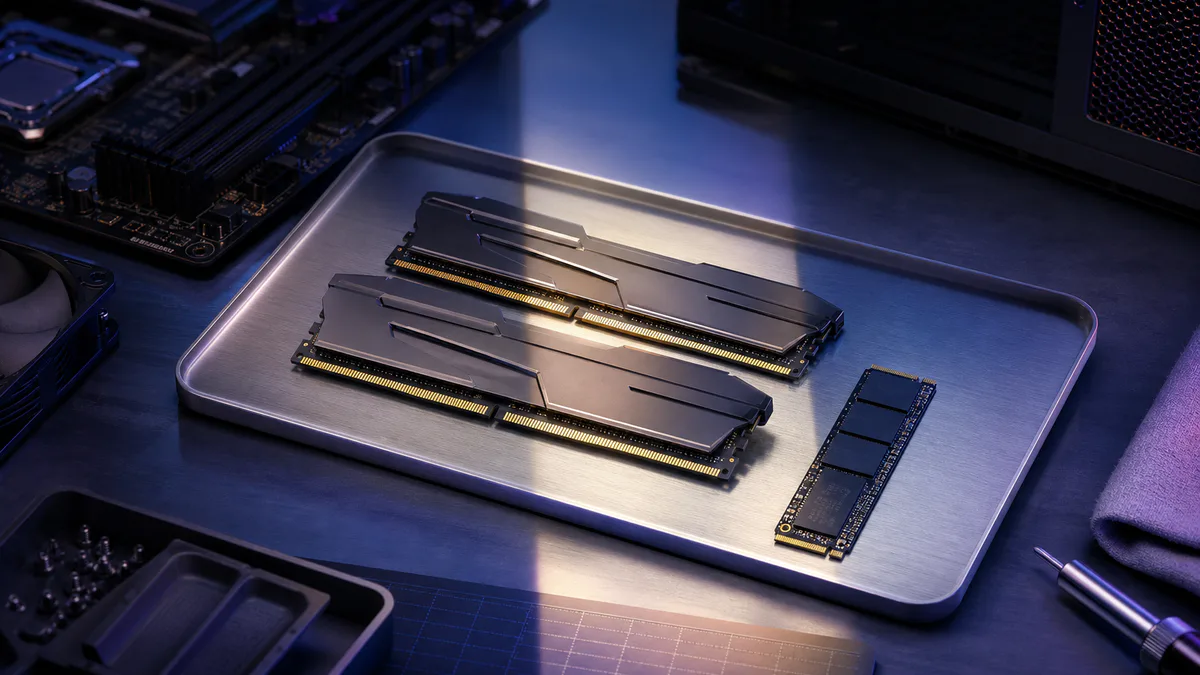


Memory is the component to watch this season. The Register reports that a memory maker has locked in historically high memory prices for five years. At the same time, at least one major device maker is shipping cheaper machines with less RAM than buyers might expect, and Prime Day is cutting prices on RAM kits and SSDs in the same week. For anyone deciding between upgrading and replacing, those facts point one way: treat this sales window as a chance to secure memory and storage, and check how much RAM a new device actually includes before you buy.
What the price reports mean
The locked-in pricing report concerns the supply side, not the shelf price today. It matters because memory pricing is cyclical, and a multi-year floor at high levels reduces the odds of the steep discounts that have historically followed gluts. If that holds, cheap RAM and storage during a sales event is worth more than it would be in a falling market. The practical reading: discounts now deserve more attention than usual, because the next big drop may be further off.
The second signal is what makers do with high memory costs. Microsoft added cheaper Surface devices that ship with 8GB of RAM instead of 16GB, according to The Verge, with the specced-down Surface Pro listed at $849 and the Surface Laptop at $949. A lower headline price with half the memory is a way to hold a price point while costs rise. It is not inherently a bad deal, but the RAM figure is where the saving comes from, and 8GB is a meaningful constraint for multitasking and for a machine you intend to keep for years.
The Prime Day discounts, read plainly
The deals are broad. Tom's Hardware notes Prime Day PC hardware discounts spanning GPUs, CPUs and SSDs. A few concrete examples give a sense of the range.
- RAM: Les Numériques reports a Corsair DDR5 16GB (2x8GB) kit dropped to 229,99€ from 389,99€, a stated 160€ reduction.
- Internal SSD: The Samsung 990 Pro 1TB was offered at 167,99€, a roughly 13% cut, per Les Numériques.
- Portable SSD: ZDNet reports the Lexar ES5 at $295, described as its lowest price in 30 days and 26% off.
Note the gap between the headline cut and the underlying value. The Corsair kit's 160€ reduction is large in absolute terms; the Samsung SSD's 13% is solid but not exceptional. Compare against the standing price, not the crossed-out figure, which sellers control. A "lowest price in 30 days" claim, as with the Lexar drive, is a narrower guarantee than "lowest ever."
Buy memory, or buy a machine?
For builders and upgraders, the case is straightforward. If your platform supports it, adding RAM or an SSD now is cheaper than it may be later, and these components are the easiest way to extend the life of a working machine. Confirm your motherboard's supported memory type and speed before buying a kit; DDR4 and DDR5 are not interchangeable. Our glossary covers the terms.
For laptop shoppers, the memory math runs the other way. Most thin-and-light laptops solder their RAM, so the figure on the spec sheet is the figure for the life of the machine. That makes the Surface examples a useful warning: a lower price with 8GB is a different product from the 16GB version, not a discount on the same one. Two discounted laptops show the alternative. 01net reports a Dell 16-inch with an Intel Core 7, 16GB of RAM and a 1TB SSD, and a Lenovo Yoga Slim 7 ultraportable with a Ryzen AI 7 350, 32GB of RAM and a 1TB SSD, both cut on Amazon. Those configurations carry enough memory to age well. Compare laptops on spec before you commit.
What to do this week
- Upgraders: if your system takes more RAM or another drive, this is a reasonable window to buy. Check compatibility first.
- Laptop buyers: read the RAM figure as a permanent spec. Treat 8GB as a budget compromise, not a deal, and favour 16GB or more on a machine you plan to keep.
- Everyone: verify discounts against recent street prices, not list prices, and be wary of low-RAM configurations dressed up as savings.
The components on sale are genuine and the timing is favourable. The risk is paying a normal price for half the memory. More on the components market on our computing news page.