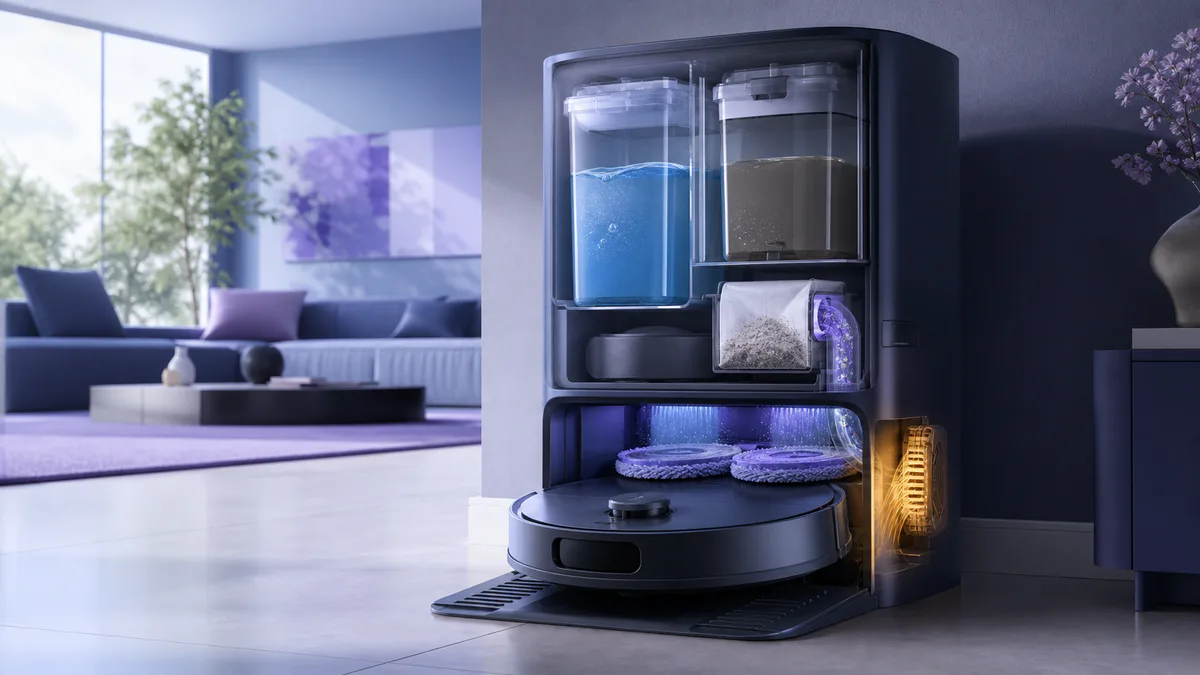

Mid-range robot vacuums are increasingly sold with an "all-in-one" dock: the same robot, paired with a station that empties it, washes its mop pads, or both. The marketing term is "maintenance-free", but the features it covers are not equal. Some remove a recurring chore; others move that chore from the robot to the station and add a running cost. This guide separates the two, so the dock premium can be judged before purchase.
What an all-in-one dock includes
A dock is best understood as a bundle of distinct capabilities, each with its own payback:
- Auto-empty: the dock empties the robot's onboard bin into a larger reservoir, usually a disposable bag.
- Mop auto-wash: the dock rinses the mop pads after a clean.
- Auto-dry: the dock dries the washed pads, often with heated air.
- Water management: clean- and dirty-water tanks that refill the robot's mop tank automatically.
- Self-cleaning wash bay: the dock cleans the tray in which it rinses the pads.
A station may offer one of these or all five, usually under a single price increase. For the underlying terms, see our glossary.
Features that remove effort
Auto-empty is the clearest benefit for most buyers. A robot's onboard bin is small and otherwise needs emptying after most cleans; with a dock, that becomes a task measured in weeks rather than days. It also avoids the dust raised by emptying the bin by hand, which matters for allergy sufferers.
Mop auto-wash with auto-dry is the second genuine gain, because it removes the unpleasant task of rinsing dirty pads by hand. The heated-dry step is not cosmetic: damp pads left in place develop odour and mildew, so drying is what keeps the mopping function usable over time. For households that mop regularly, the two together justify the premium.
Features that relocate the chore
Several capabilities reduce effort on the robot but add it at the station. Water management is the clearest case: clean- and dirty-water tanks spare the robot's small onboard tank, but the dock tanks still require regular refilling and emptying, and the tray needs periodic cleaning. The maintenance moves; it does not disappear.
The self-cleaning wash bay determines whether a mop dock is a net gain. The bay rinses dirty pads repeatedly; without self-cleaning, it accumulates residue and odour and becomes a cleaning task in itself. On a mop-capable model, treat a self-cleaning bay as a requirement rather than an extra; our vacuum comparison flags which models include one. Hair remains a manual job on every dock: long and pet hair still tangles the brushroll and has to be cut free by hand.
The running costs
The dock premium is not the only cost. Auto-empty docks generally use proprietary disposable bags bought from the manufacturer, and the empty cycle is noticeably loud each time the robot returns. Wash-and-dry features add the most: they consume water and electricity, with heated drying drawing meaningfully more power. Over a year, the recurring spend covers bags, replacement pads, filters, recommended detergent, and the water and power for any wash-and-dry model. The stations are also large and contain more components — pumps, heaters, tanks — each a potential point of failure.
Recommendation
Buy a dock for the features that remove work, not for the full specification. Auto-empty is worth it for most buyers, particularly allergy households, at a modest and predictable running cost. Auto-wash with heated dry is worth it for those who mop often — but only with a self-cleaning wash bay. Water-tank management relocates work rather than removing it, hair stays a manual job, and the footprint and running costs are real. Buyers who rarely mop should skip the wash-and-dry tier and put the budget toward a better-cleaning robot instead; our ranking shows where the machines themselves stand.