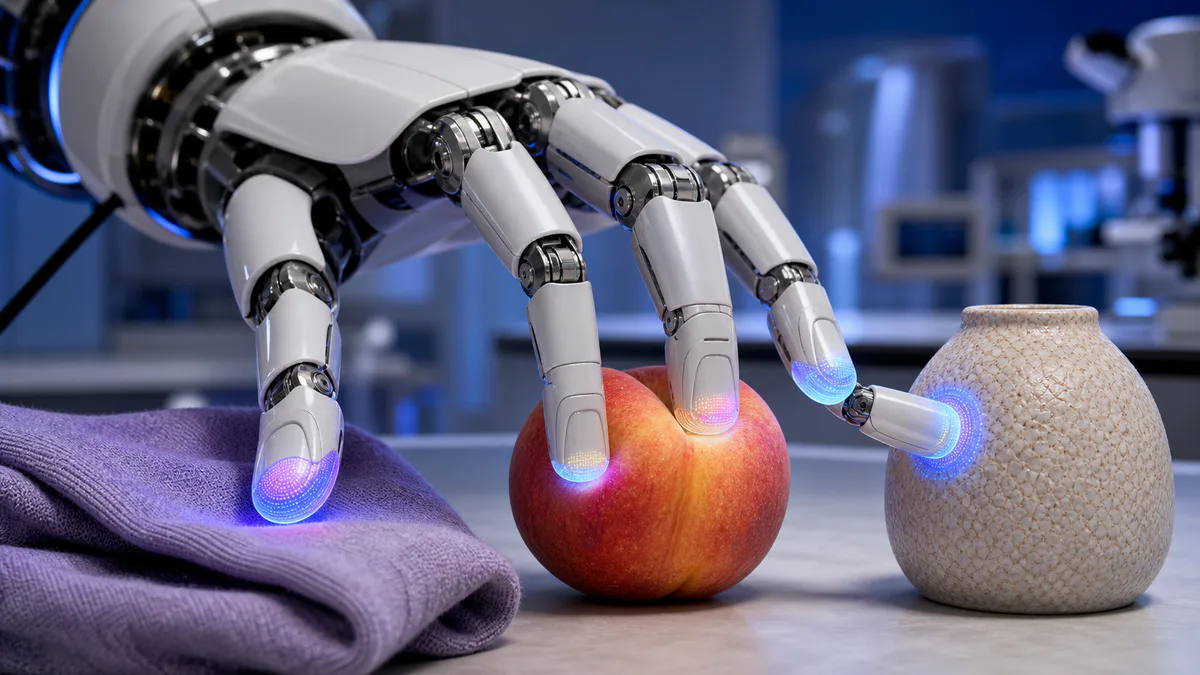
Consumer attention this week went to humanoids that walk and run. The more important robotics story sits elsewhere. Across a dozen independent items in the week's feed, one problem kept surfacing: giving robots a sense of touch so they can handle unfamiliar objects without crushing or dropping them. The clustering is the signal. Tactile sensing and dexterous manipulation are where serious work is now concentrating.
This matters for buyers because locomotion is largely solved. Robots reliably walk, run and recover. Useful, unsupervised manipulation of everyday objects in unstructured spaces is not solved. That gap is why a machine can do a backflip but cannot be trusted to load a dishwasher. If you are judging a home robot, judge it on its hands.
The demos: read them as research, not product
At ICRA 2026 in Vienna, a demonstration of two robotic hands making a balloon-dog drew outsized attention. IEEE Spectrum framed "contact" as defining robotics' next era. The framing is sound. The balloon-dog is a research preview, not a capability you can buy.
The same caution applies to the most-shared integration of the week. Robotics & Automation News reported that Sharpa's Wave tactile hands have been integrated into the Unitree H2 Plus reference design — described as the first dexterous humanoid platform on Nvidia's Isaac GR00T to feature its tactile manipulation tech. Isaac GR00T is a developer framework and reference stack. Building a tactile hand onto a GR00T-based platform is an attempt to standardise dexterity across robot makers, not a one-off demo. That is meaningful for the industry. It is not a shipping product.
The field is building yardsticks it lacked
A sign of a maturing problem is shared measurement. The Robot Report reported that Daimon Robotics and Galbot launched RobOmni, a tactile-manipulation benchmark, framed around moving from vision-centric perception toward "Physical AI." Touch has lacked common benchmarks. Building them is unglamorous and necessary, and it signals that the field expects to compete on this capability for years.
Research groups are attacking touch from several directions at once. Interesting Engineering covered an octopus-inspired robotic arm using distributed tactile sensors for adaptive grip. Robohub reported Cornell researchers using stretchable fibre-optic sensors to build a soft gripper that predicts strawberry ripeness by touch and picks fruit without bruising. The variety of approaches is healthy. It also tells you no single method has won.
Where the tech actually ships
Two items point to where this technology earns its keep today: industry and teleoperation. Robotics & Automation News reported that Festo launched GripperAI, software that lets robots handle mixed, unfamiliar and randomly positioned products without extensive programming or specialist vision. It is aimed at manufacturing, where structure and supervision make manipulation tractable now.
The bridge to dexterity often runs through a human. The Next Web reported that an MIT ultrasound wristband tracks 22 degrees of freedom in the hand and controls a robotic hand in real time, with the research published in Nature Electronics in March 2026. Teleoperation is a current workaround for autonomy nobody has, not a replacement for it. The same anchoring shows in research scope: a Robohub "Robot Talk" episode with Heriot-Watt's Maria Koskinopoulou covered autonomous manipulation for surgery and industry — specialised, supervised domains.
What this means for a home robot
The pattern is consistent. Tactile manipulation is advancing, but the advances live in industry settings, in research labs, or under human supervision. None of that is the unsupervised, general-purpose hand a home robot needs to be useful. For how manipulation is defined and measured, see our glossary, and for ongoing coverage our robotics news page.
So when a "coming soon" humanoid arrives with a walking video, the question to ask is what its hands can do without a teleoperator and without prior programming. That is the gate, and the week's news confirms it has not been cleared. If you are comparing platforms, our humanoid comparison is the place to weigh hardware against this standard.
The takeaway
Touch was the real robotics story this week, and the honest reading is mixed. Progress is real and broad, but it remains concentrated in manufacturing, supervised teleoperation and the lab. Dependable, unsupervised hands — the one capability that would make a general home robot worth buying — still do not exist. Buy on manipulation, not locomotion, and treat every viral hand demo as a research preview until a product proves otherwise.