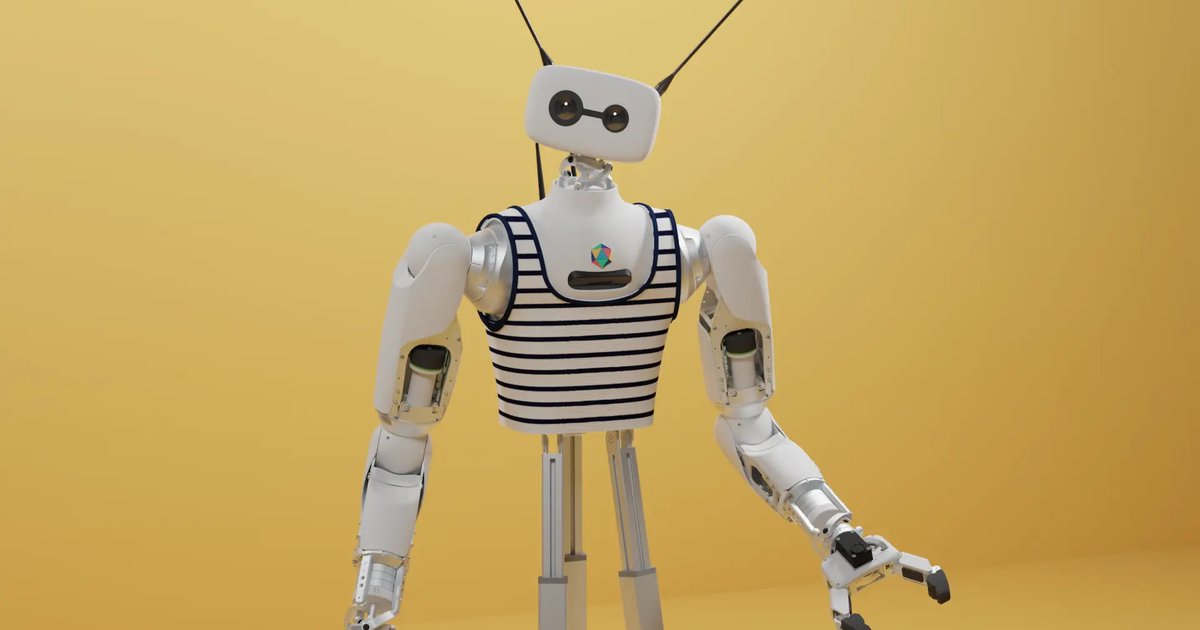
Pollen Robotics Reachy 2
Open-source bimanual humanoid on an omnidirectional base, built by Pollen Robotics (Hugging Face) for AI and robotics research labs, with VR teleoperation.
Sold to research labs such as Cornell and Carnegie Mellon; Pollen has been part of Hugging Face since April 2025.
Good humanoid robot (69/100). It stands out most for battery life (100/100). Highlight: fully open-source software. Main trade-off: only 3 kg per arm.
Score breakdown
Rated across 6 criteria
Specifications
- Availability
- Shipping
- Payload
- 3 kg
- Runtime
- 600 min
- Height
- 166 cm
- Weight
- 50 kg
- Locomotion
- Wheeled
- Main use
- Research
- Made in
- France
- Year
- 2024
- SDK
- Open SDK
- Announced price
- US$70,000 (reported)
Specs checked September 2026. Sources: pollen-robotics.com, archive.org, therobotreport.com, deeplearning.ai, x.com. A missing value has not been published by the maker.
Pros
- Fully open-source software
- ROS 2 and Python SDK
- VR teleoperation included
Cons
- Only 3 kg per arm
- Simple parallel grippers
- No legs
Owner reviews
A strong humanoid robot with real strengths
In our independent assessment, the Pollen Robotics Reachy 2 earns 69/100 — a good humanoid robot.
Its strongest area is battery life (100/100), followed by availability (100/100). In practice, fully open-source software.
The main caveat is payload, where it scores 63/100. Specifically, only 3 kg per arm.
At €60200, it sits at the premium end of the category. A dependable pick if its strengths line up with your priorities.
Community reviews
No community reviews yet. Be the first to share yours.
Want to review the Pollen Robotics Reachy 2 ?
Sign in to write a reviewFrequently asked questions
Can I actually buy a humanoid robot?
Yes, but mostly research and developer models (Unitree, Booster, EngineAI and others) that ship today. Most general-purpose humanoids are still in paid pilots, pre-order or prototype: check the Availability line before you plan around one.
How much does a humanoid robot cost?
Small developer humanoids start at a few thousand euros; full-size research platforms start around 17,000 € and advanced ones reach about 100,000 € or more. Industrial humanoids are usually sold or leased on quote, so no public price is listed.
What can humanoids do today?
Current models walk, balance, carry modest payloads and perform scripted, learned or teleoperated tasks. Fully autonomous household help is still emerging.
What do degrees of freedom (DoF) tell me?
Each DoF is one joint axis the robot can move. More DoF, especially in the hands, means more dexterous manipulation, but also more to calibrate and maintain.
Do they come with an SDK?
Research-focused humanoids ship with an open SDK or ROS support for programming and experiments; commercial units are typically locked to the vendor's software.
Compare the Pollen Robotics Reachy 2 with the top alternatives
Score, price and specs, side by side.
Alternatives from other brands
Other humanoid robots worth comparing