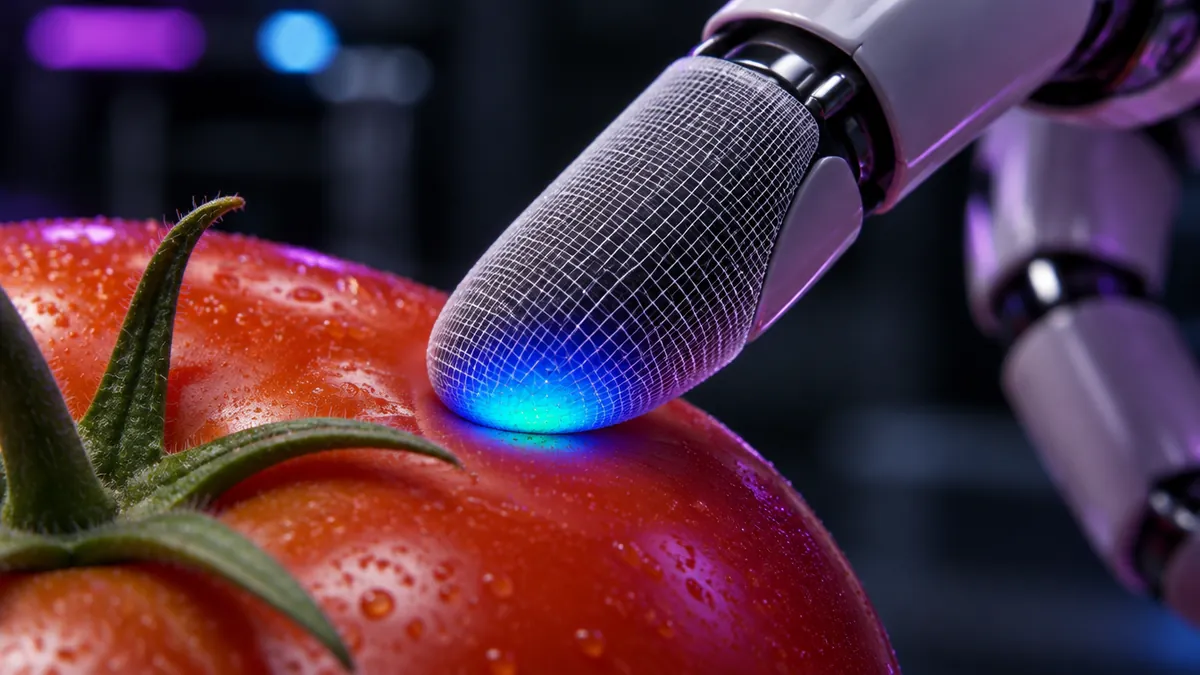
Spec sheets for humanoid robots tend to lead with degrees of freedom, payload and walking speed. None of those numbers explain why a robot drops a cup, crushes an egg, or fumbles a tool it was supposed to hand over. That failure sits in touch perception, a capability that rarely gets a line on a comparison chart but increasingly decides whether a robot works outside a demo video.
A new open-source release puts that gap in focus. Robbyant, an embodied AI company within Ant Group, has open-sourced LingBot-Touch, a tactile foundation model built to give robots robust touch perception, according to Robotics & Automation News. Robbyant describes tactile sensing as a critical capability that has been largely missing from robotics to date.
Touch is also the sense humanoid programs have invested in least, relative to vision. A robot can see an object clearly and still misjudge how hard to grip it or whether it has started to slip. LingBot-Touch targets that specific gap: a model-level understanding of contact and force, not just cameras pointed at a hand.
Why touch is hard to compare
Vision and locomotion are easy to demo and easy to compare: a robot either walks on stairs or it doesn't, a camera either resolves an object or it doesn't. Tactile competence shows up differently, in the long tail of grip failures, dropped objects and overcorrected force that a short demo clip rarely captures. That's one reason it has stayed off spec sheets, even though it matters once a robot has to handle anything fragile or irregular outside a controlled run.
Open-sourcing a tactile foundation model changes that calculus. If touch perception is modular and shareable the way LingBot-Touch is positioned, buyers and integrators can evaluate it, or swap it in, rather than treat it as a black box baked into one vendor's stack. Anyone using our humanoid spec comparison to shortlist a platform should ask vendors directly what tactile sensing hardware and model they run, not assume it's solved because the hand has sensors.
The 2026 AI100 report names the problem
This isn't one company's marketing claim. Robohub reports that the 2026 edition of the AI100 report, a periodic assessment of the AI field, named embodied AI a "grand challenge" for research. That classification signals the research community still sees a real gap between a robot that performs in a controlled demo and one that performs reliably in unstructured, physical environments, with touch perception among the harder pieces of it.
That context explains why otherwise capable-looking platforms, tracked on our price tracker still struggle outside curated environments. Grippers, actuators and degrees of freedom have matured faster than the perception stack that tells a robot what its hardware is actually touching.
The compute race behind embodied AI
Training models like LingBot-Touch depends on compute that is increasingly contested and unevenly distributed. CoreWeave, a cloud provider for AI, signed a multi-year deal with Wayve to accelerate training of Wayve's AI Driver foundation model for autonomous vehicles, according to Robotics & Automation News. The deal isn't about humanoids, but it illustrates the scale of compute now committed to large perception models in general, the same category tactile foundation models fall into.
Not all of that compute runs on Nvidia hardware. The Decoder reports that Meituan released the weights for LongCat-2.5, a 1.6-trillion-parameter agent model trained entirely on Chinese hardware without any Nvidia GPU, evidence that Nvidia dependency isn't a given at this scale. Separately, MarkTechPost reports that Google released TPU Sync, an open-source library for moving KV caches and weights across TPU memory, storage and network, with over 90% lower KV transfer latency reported on large mixture-of-experts models.
The dollar figures involved are larger still. The Decoder reports that Anthropic's compute commitments now total nearly $901 billion ahead of its IPO, with CEO Dario Amodei calling compute purchasing the deepest business dilemma the company faces. That figure comes from the general-purpose AI model market, not robotics, but it sets the scale against which embodied AI's own compute needs, tactile models like LingBot-Touch included, will have to compete for supply.
What this means for buyers
None of this changes what a humanoid robot can do today. It does change what buyers should ask before committing to a platform. Degrees of freedom and payload ratings are necessary information, but they say nothing about whether a robot can pick up an unfamiliar object without crushing or dropping it. That question lives in the perception and training stack, not the datasheet.
Treat tactile sensing, and the model behind it, as a first-order spec alongside the mechanical numbers in our best humanoid robots ranking. Ask which model a platform uses, whether it's open like LingBot-Touch or proprietary, and whether anyone outside the vendor has verified it. A single successful grip in a demo doesn't prove reliable tactile perception: ask for trials on unfamiliar objects, not a highlight reel. Follow ongoing coverage in our robotics news.
Sources: Robotics & Automation News, Robohub, The Decoder, MarkTechPost
Written with the help of AI tools, from published sources, under our editorial rules. Illustration generated with AI. No commission on purchases. Learn more