Humanoid robots spent the first part of this decade on keynote stages. The latest round of announcements points somewhere more useful for anyone trying to work out which maker is actually close to shipping: energy infrastructure and logistics operations.
A utility pilot, not a demo
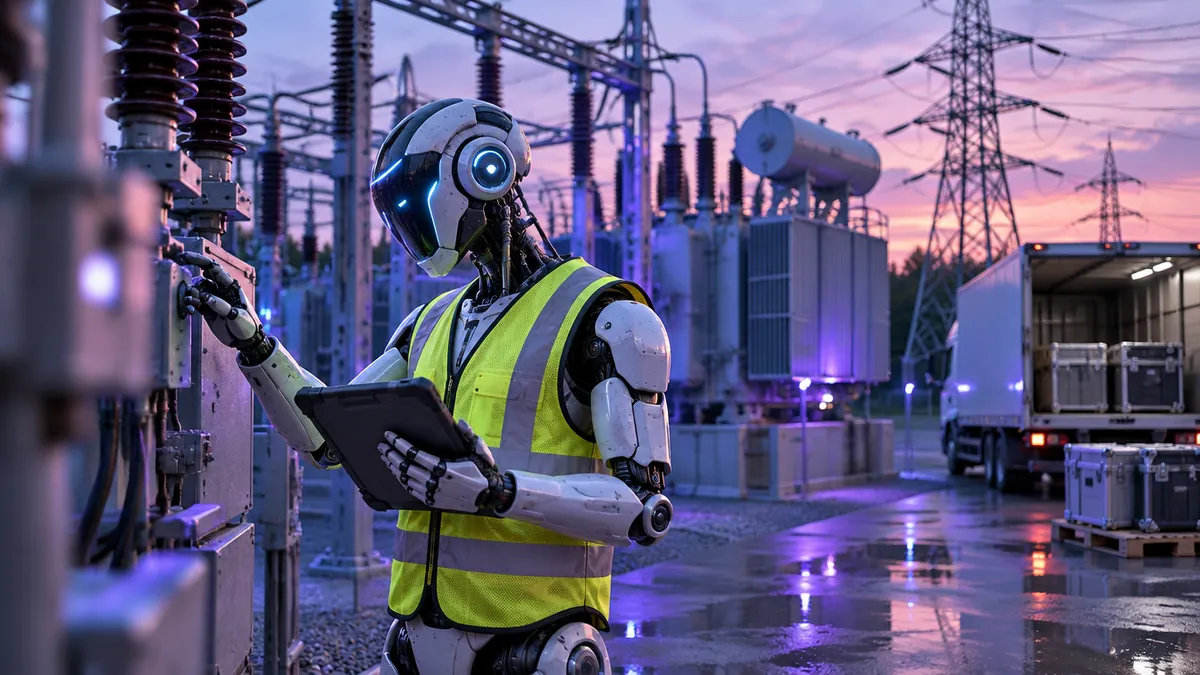
Neura Robotics has partnered with E.ON and enviaM to develop physical AI applications for electricity networks, according to Robotics & Automation News. The collaboration targets real-world trials on grid infrastructure starting in 2027.
That timeline matters more than the announcement itself. A 2027 trial date is a long runway, and nothing here confirms commercial deployment follows. But testing on live electricity infrastructure, rather than in a lab or on a trade-show floor, is a different category of validation than most humanoid demos offer. Which Neura platform ends up on utility sites has not been specified. Readers tracking the broader field can compare specs on the humanoid comparison page.
Logistics: a completed project, not a pilot
Separately, South Korean logistics specialist Expoline has completed a multimodal international transportation and on-site logistics project involving humanoid robots, Robotics & Automation News reported. Unlike the Neura/E.ON partnership, this is described as finished work rather than a future trial.
That distinction matters. Most humanoid news this year has been pilots, MOUs and partnership announcements with dates attached. A completed cross-border logistics deployment is a step further along: it implies the robots moved, worked, and the project closed out. Robotics & Automation News did not specify which humanoid platform Expoline used, the scale, or the outcomes, so this is a data point on momentum rather than a verified benchmark. Buyers evaluating humanoid options for warehouse or logistics use can track current list prices on the price tracker.
Hardware: GENTO's decade-long sensor stack
At CoRL 2026 in Austin, GENTO showed humanoid robots and a new dexterous hand, according to Robotics & Automation News. The hardware, built by Tianji Intelligence, has reportedly been in development since 2015, starting from a single sensor-level component and building outward.
A 2015 start date is notable in a field where most entrants are recent. It suggests GENTO's pitch is depth of hardware engineering rather than speed to market, though CoRL is an academic robot-learning conference, not a product launch venue, and no pricing, availability or deployment plans were disclosed. The best humanoid robots ranking covers platforms with more public deployment history.
Software: the stack is still unsettled
Two developments on the AI side complicate any simple read on hardware readiness. The Decoder reports that OpenAI is dissolving its standalone robotics team for the second time, with general-purpose models such as GPT-6 Astra apparently capable of controlling robots directly.
At the same time, Runway released Praxis-1, an open-source robotics model under the Apache 2.0 license that draws on knowledge from video training for robot control, per The Decoder. Praxis-1 currently leads the World Action Model category on Nvidia's benchmark.
Put together, these signal a split that matters to buyers: OpenAI is betting general-purpose models absorb robot control as a capability, while Runway is building (and open-sourcing) a dedicated robotics model trained on video. Neither approach has converged with a specific hardware platform in a way that produces a buyable product yet. See more robotics news for ongoing coverage as these stacks mature.
What this means for buyers
No consumer humanoid is available to buy today, and that has not changed with this round of news. What has changed is where the credible signal sits: not in keynote choreography, but in named industrial and energy partners, trial dates, and a completed logistics deployment. For anyone deciding which maker to watch, the near-term tell is a named energy or logistics customer with a dated pilot, not the slickest demo video. Both hardware (GENTO's decade of sensor work) and software (OpenAI's and Runway's diverging bets) remain in flux, which means platform choice is still a moving target for buyers planning beyond 2027.
Sources: The Decoder
Written with the help of AI tools, from published sources, under our editorial rules. Illustration generated with AI. No commission on purchases. Learn more